
What if the most powerful tool in your lighting rig is also the one you're most afraid to use? Many Australian event organisers and technicians feel a genuine sense of hesitation when it comes to the strobe light. You want that heart-pounding energy that only a high-intensity flash can provide, but the fear of triggering health issues or creating a chaotic, uncoordinated mess often leads to playing it too safe. It's a common frustration, especially when you're trying to distinguish a professional-grade atmosphere from a basic party setup.
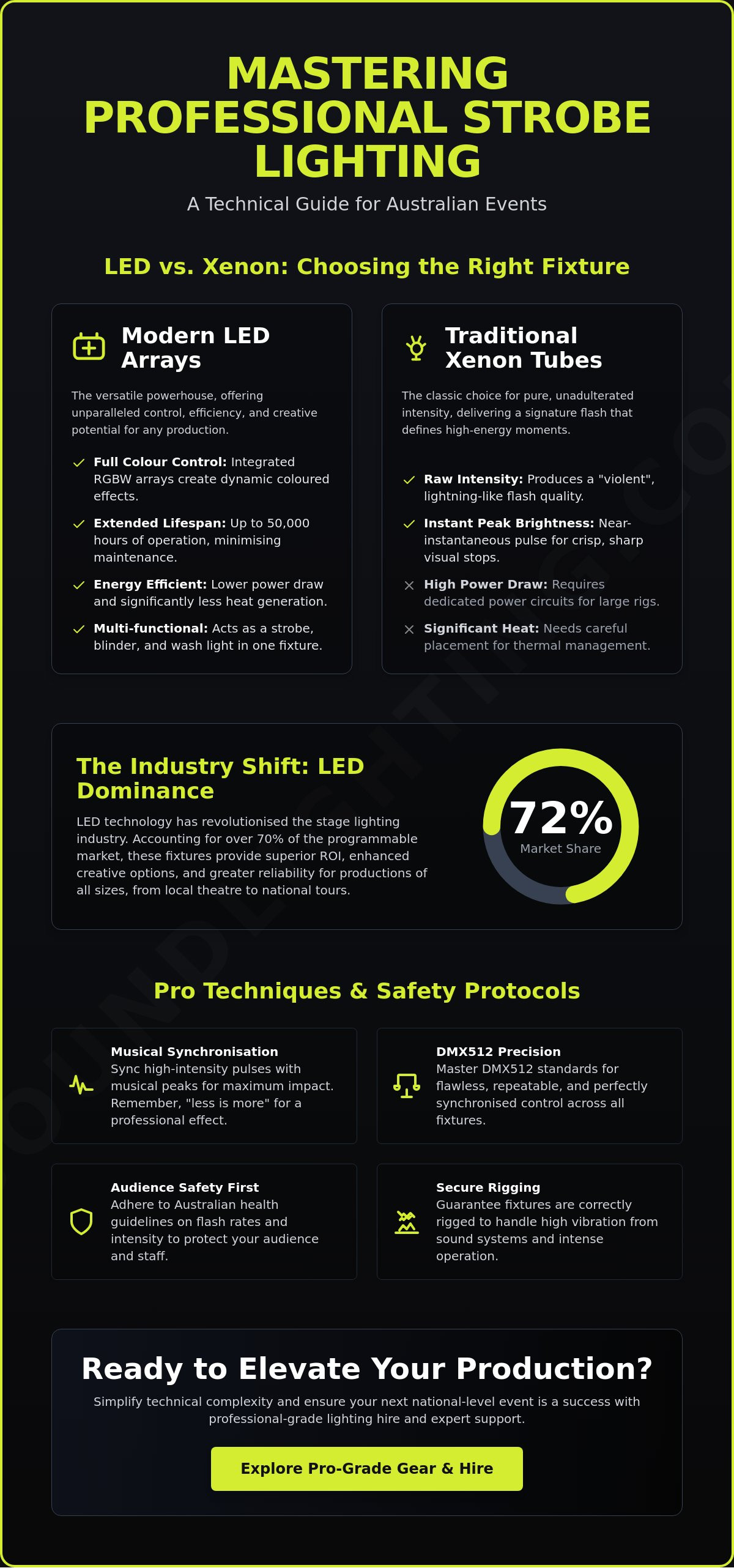
We're here to help you move past that uncertainty. This guide will transform your approach by showing you how to master professional strobe technology with precision, safety, and creative flair. We'll explore the industry shift toward high-efficiency LED fixtures, which now account for over 70% of the programmable market. You'll also learn the latest DMX512 standards for flawless synchronisation and the specific timing techniques required to protect your audience while delivering a world-class visual experience. Whether you're planning a local production or hiring gear for a national-scale event, you'll find the expert insights needed to execute your vision with total confidence.
Key Takeaways
- Understand the critical evolution of the strobe light from traditional Xenon tubes to modern LED arrays that offer superior colour control and energy efficiency.
- Learn professional "less is more" techniques that allow you to sync high-intensity pulses with musical peaks for maximum atmospheric impact.
- Master the latest DMX512 standards and safety protocols to ensure your lighting effects remain compliant with Australian health and safety guidelines.
- Identify the specific rigging and power requirements for high-vibration fixtures to guarantee a secure and professional setup for any large-scale production.
- Discover the benefits of an all-in-one approach to lighting hire that simplifies technical complexity and ensures your national-level event is a success.
Understanding Strobe Lights: More Than Just a Flash
A professional strobe light is far more than a simple blinking bulb. It is a high-intensity pulse fixture specifically engineered to deliver sharp, rhythmic bursts of light that command immediate attention. While many see it as a chaotic effect, the seasoned lighting professional views it as a precision instrument for manipulating the audience's perception of time and energy. When you integrate these fixtures into your rig, you aren't just adding brightness; you're sculpting the atmosphere of the entire venue.
It's vital to distinguish between professional stage fixtures and the consumer-grade "disco lights" often found in retail shops. Professional units offer granular DMX control, massive lumen output, and sophisticated thermal management systems that prevent the unit from shutting down during a high-energy set. In the Australian event production landscape, whether for large-scale outdoor festivals or intricate indoor theatre productions across the country, the reliability of your gear is non-negotiable. High-grade strobes provide the punch required to cut through dense stage fog and compete with high-output LED screens, ensuring your visual cues land with absolute impact.
The Science of the Stroboscopic Effect
The magic happens when rapid pulses of light "sample" motion in a dark environment. By firing flashes at specific intervals, you can make a fast-moving performer appear as if they are moving in slow motion or even frozen in mid-air. This effect relies heavily on flash duration. Professional fixtures can produce pulses lasting only microseconds, which is essential for achieving those crisp, sharp visual "stops" without any blur. The stroboscopic effect is the persistence of vision meeting high-frequency light pulses.
The Evolution of Professional Strobe Technology
We've seen a remarkable journey from the early mechanical shutters and simple Xenon tubes to the digital, DMX-controlled powerhouses of today. Modern technology has led to the rise of multi-functional fixtures that are changing how we design shows. Many of the latest units act as both a high-intensity strobe light and a versatile wash light, allowing designers to maximise their budget and rig space. For national touring rigs, build quality is the most important factor. These fixtures must be rugged enough to handle the constant vibration of high-decibel sound systems and the rigours of being transported across the country from venue to venue.
LED vs. Xenon: Choosing the Right Fixture for Your Venue
Selecting the right strobe light for your venue requires a balance between raw visual impact and long-term operational efficiency. While the industry has seen a massive shift toward digital solutions, the choice between traditional Xenon tubes and modern LED arrays remains a pivotal decision for any lighting designer. Each technology offers a distinct texture of light that influences how an audience perceives the energy on stage. Understanding the Basics of Good Stage Lighting Design is essential when deciding which technology will best highlight your performers and create the desired atmosphere.
The Rise of LED Strobe Technology
LED technology has redefined what's possible in a single fixture. By 2023, LED fixtures accounted for 71.83% of the programmable stage lighting market, and it's easy to see why. Modern LED strobes aren't just for flashing; they often feature RGB or RGBW arrays that allow you to create high-energy coloured effects without the need for physical gels. One of the most significant advantages is the "blinder" mode. Unlike older units, LEDs can stay at full intensity for extended periods without the risk of overheating or melting internal components. For venues looking at long-term ROI, the 50,000 hour lifespan of an LED array far exceeds the maintenance cycle of any gas-discharge tube.
Traditional Xenon Strobes: When Intensity is Key
Despite the versatility of LED, traditional Xenon strobes still hold a place in professional touring rigs. There's a specific "violent" quality to a Xenon flash that LEDs struggle to replicate perfectly. This comes down to the pulse decay. A Xenon tube reaches peak brightness almost instantly and has a unique trail-off that feels more organic and "lightning-like" to the human eye. However, this intensity comes at a cost. These units draw significant current, often requiring dedicated power circuits for large-scale national event rigs. They also generate substantial heat, meaning they require careful placement to ensure proper thermal management during a show.
When you're capturing events for broadcast or social media, colour temperature becomes a critical factor. Xenon units typically sit around 5600K, providing a crisp, cool white that looks brilliant on camera. LEDs offer more flexibility here, but you must ensure your fixtures have a high refresh rate to avoid flickering on digital sensors. If you're planning a permanent installation or a large-scale tour, exploring professional stage lighting solutions can help you navigate these technical trade-offs. Whether you prioritise the raw punch of Xenon or the multi-functional efficiency of LED, your choice will ultimately define the visual signature of your production.
Professional Techniques for High-Impact Stage Lighting
Mastering the strobe light requires a disciplined "less is more" philosophy. While it's tempting to lean on high-intensity flashes during every energetic moment, overusing the effect quickly fatigues the audience's eyes and diminishes its overall impact. Professional lighting designers use strobes as a punctuation mark rather than the whole sentence. By keeping the fixtures dark for most of the performance, you ensure that when the strobe light finally fires, it creates a genuine "wow" moment that shifts the room's energy instantly.
Timing is the most critical element of this technique. You'll achieve the best results by synchronising your pulses with the "drop" in electronic music or the rhythmic peaks of a drum solo. In a professional DMX environment, you can map the flash rate to the BPM of the track, ensuring every pulse lands perfectly on the beat. Another advanced method is "blind strobing." By triggering a sustained, high-intensity burst, you can momentarily overwhelm the audience's vision to mask a quick transition on stage, such as a performer entering or the rapid repositioning of moving heads. This creates a seamless, almost magical shift between different stage looks.
Creating the Iconic Slow-Motion Visual
To achieve that classic frozen-in-time effect, you must manage your ambient light levels with precision. If your wash lights or parcans are too bright, the stroboscopic effect will appear washed out and blurry. Follow these steps for a crisp result:
- Kill or significantly dim all background wash and house lights to maximise contrast.
- Set your flash frequency between 4Hz and 9Hz for human movement. This range is the "sweet spot" for visualising distinct frames of motion.
- Ensure your flash duration is set as short as possible. Longer pulses introduce motion blur, which ruins the illusion of a frozen frame.
Layering Strobes with Smoke and Fog FX
Strobes truly come alive when they have something to "hit" in the air. By layering your light pulses with particulates from Stage FX Lighting, you transform flat flashes into three-dimensional sculptures of light. There's a distinct difference in the result based on the medium you use. Haze creates a subtle, atmospheric shimmer that defines the beams of light without obscuring the performers. In contrast, thick fog creates dense "clouds" of light that can make the entire stage feel like it's vibrating. When you're designing for a high-energy Australian festival or a local club night, coordinating your fog output with your strobe cues is the fastest way to elevate a standard show into a professional-grade production.
Safety, Control, and Rigging Requirements
Executing a high-energy show requires more than just creative vision; it demands a rigorous commitment to technical control and public safety. When you integrate a strobe light into a professional rig, you're dealing with high-vibration equipment that places unique stresses on your infrastructure. Professional DMX control is the only way to manage these fixtures reliably. Most high-end units utilise a multi-channel DMX profile that separates "intensity" from "rate." While intensity governs the brightness of each pulse, the rate determines the frequency of those flashes per second. Mastering this distinction allows you to dial in the exact energy level required without overwhelming your power circuits or your audience.
Rigging these fixtures requires extra attention to detail. Because strobes can produce rapid, repetitive physical vibrations, especially in older Xenon models, you must ensure your mounting is rock-solid. Always use heavy-duty rated clamps and secondary safety cables attached directly to the truss. This is particularly important for national touring rigs where gear is subjected to different mounting environments every night. To ensure your setup meets professional standards, you can organise a professional AV installation that prioritises both visual impact and structural integrity.
DMX Programming and Synchronisation
For a polished look, you need to avoid "clashing" strobes. When multiple units fire out of sync, the result often looks messy and uncoordinated. By utilising the latest ANSI E1.11-2024 DMX standards, you can synchronise every fixture in your rig to fire in perfect unison. Alternatively, you can use the "random strobe" function found in modern consoles like the grandMA. This creates an organic, chaotic energy that feels more like natural lightning, which is often more effective for rock and electronic sets than a rigid, mechanical pulse.
Managing Health Risks and Epilepsy Warnings
Public safety is your primary legal and ethical responsibility. Industry standards recommend limiting strobe sequences to 30 seconds and ensuring flash rates stay below 4Hz when possible. Research suggests that the most critical danger zone for photosensitive epilepsy is between 3Hz and 30Hz, so staying outside this range is a vital precaution. In Australia, venues are legally required to display clear signage at every entry point. This signage must be positioned at eye level and explicitly state that strobe lighting will be in use. Finally, consider the placement of your fixtures. Aim to rig strobes at a height and angle that avoids direct, blinding eye contact with the front-row audience, focusing instead on illuminating the air or the stage floor for a more professional, immersive effect.
Elevate Your Production with Pro Sound & Lighting
Bringing a high-energy vision to life requires more than just a theoretical understanding of lighting physics. It demands a partner who has navigated the complexities of the Australian entertainment industry for over 20 years. Pro Sound & Lighting stands as a veteran in the field, offering a comprehensive, all-in-one approach that bridges the gap between creative concepts and flawless technical execution. Whether you're looking to install a permanent strobe light array or need a high-impact rental rig for a one-off festival, our team provides the seasoned expertise necessary for national-scale success.
Technical complexity shouldn't be a barrier to your creativity. Our role is to remove the stress of equipment selection and synchronisation, allowing you to focus on the performance itself. By combining our deep inventory of professional fixtures with a practical, customer-focused attitude, we ensure that every pulse of light and every beat of sound works in perfect harmony. You don't just get a supplier; you gain a collaborative partner dedicated to achieving a superior outcome for your venue or event. We pride ourselves on being the reliable visionary you need to turn a standard stage into an immersive experience.
Custom AV Installations for Australian Venues
Designing a permanent lighting rig involves more than just bolting fixtures to a truss. We take a holistic view of your space, meticulously integrating high-intensity strobes with your existing sound and visual systems. Our team excels at complex architectural and stage requirements, bringing a "can-do" attitude to every project. We understand the specific Australian regulations regarding safety and power draw, ensuring your installation is not only visually stunning but also fully compliant and built for longevity. From local clubs to major performance centres, we create systems that are easy to operate yet powerful enough to handle any production level.
Professional Lighting Hire Solutions
For those managing touring shows or seasonal events, our lighting hire packages offer the ultimate in flexibility and power. We provide a massive range of Stage FX Lighting, moving heads, wash lights, and parcans, all maintained to the highest professional standards. Beyond the hardware, you benefit from our on-site expertise and technical support, ensuring your rig is optimised for the specific acoustics and layout of your venue. We make it simple to scale your production up or down based on your specific needs and constraints. It's time to move from the planning phase to a high-energy reality. Contact Pro Sound & Lighting for your next high-energy event rig and let's build something extraordinary together.
Master Your Visual Impact
Transforming a standard stage into a high-energy environment requires a delicate balance of technical precision and creative timing. You've now explored how the modern strobe light has evolved from a simple flashing tube into a sophisticated, DMX-controlled instrument capable of sculpting three-dimensional visuals. By mastering the distinction between LED and Xenon technology and adhering to rigorous Australian safety standards, you can deliver an unforgettable experience that keeps your audience safe while pushing the boundaries of stage design. The difference between a chaotic show and a world-class production lies in the expertise behind the console.
With over 20 years of industry expertise, Pro Sound & Lighting is your dedicated partner for national service coverage across Australia. We specialise in high-impact Stage FX Lighting and all-in-one AV installations that remove the stress of technical complexity for our clients. Whether you're upgrading a permanent venue or planning a major tour, we're here to help you execute your vision with total confidence. Enquire about our Professional Lighting Hire and Installations today to start building your next high-energy rig. Let's work together to create something truly spectacular.
Frequently Asked Questions
Are strobe lights dangerous for people without epilepsy?
Strobe lights are not inherently dangerous for the majority of the population, but they can cause physical discomfort if used without restraint. Excessive exposure can lead to eye strain, headaches, or a temporary sense of disorientation known as flicker vertigo. It is best practice to follow the 30-second limit for continuous sequences to ensure the comfort of all attendees and prevent visual fatigue.
What is the difference between a strobe light and a blinder?
A strobe light is designed to produce rapid, ultra-short pulses of light to freeze motion, whereas a blinder is meant to stay on at full intensity to "blind" the audience with a wash of light. While many modern LED fixtures can perform both roles, a dedicated blinder is typically used for a few seconds during a musical crescendo to create a massive wall of light that fills the entire venue.
How do I connect multiple strobe lights to a single controller?
You connect multiple units by daisy-chaining them together using high-quality DMX cables. Start by connecting the DMX output of your controller to the "in" port of the first fixture, then continue from that unit's "out" port to the next one in the series. To maintain a clean signal across the entire chain, always place a DMX terminator in the output port of the very last fixture.
Can I use LED strobe lights for outdoor events in Australia?
Yes, you can use these fixtures outdoors provided they have an IP65 rating or higher for weather resistance. In the Australian event circuit, IP65-rated units are highly preferred because they don't require disposable plastic rain covers. This is a significant advantage during summer festivals as it allows the fixture's internal cooling systems to work efficiently without the risk of heat being trapped by plastic.
Do I need a special permit to use high-intensity strobes at my venue?
You don't generally require a specific permit for the lights themselves, but you must comply with Australian health and safety regulations. This includes the mandatory placement of warning signage at all entry points to inform the public that strobes will be in use. It's also your responsibility to ensure the lighting operator adheres to safe flash frequencies to protect the well-being of the audience.
How much power does a professional Xenon strobe actually draw?
A high-output Xenon unit can draw a substantial amount of current, with 3000W models often peaking at around 12 to 15 amps during intense bursts. Because a standard Australian domestic power outlet is rated for only 10 amps, these professional fixtures usually require a dedicated 15-amp circuit with a larger earth pin. This high power requirement is one of the main reasons many venues are now opting for energy-efficient LED alternatives.
What is the best height to mount a strobe light for maximum effect?
Mounting your fixtures at a height between 3 and 5 metres generally provides the most effective coverage for a professional stage. This elevation allows the light to spread evenly across the performance area and into the air while keeping the intense light source safely above the direct eye line of the audience. Proper height also ensures that the stroboscopic effect is visible across the entire floor rather than being concentrated in one small spot.
Can strobe lights be used in photography as well as stage production?
Strobe lights are frequently used in photography to freeze fast-moving subjects or to create unique multi-exposure effects in a single frame. Unlike a standard camera flash that fires once, a stage strobe's high-frequency pulses allow a photographer to capture a "trail" of motion. You will need to carefully coordinate your camera's shutter speed with the hertz rate of the fixture to ensure the pulses align perfectly with your exposure.