
What if the difference between a standard stage setup and a world-class visual experience wasn't the size of your budget, but the physics of your beam angles? It's a common frustration for event organisers across Australia who want to create impact but feel held back by technical jargon. You know that Moving Heads are the engine of modern event lighting, yet the leap from basic wash lights to sophisticated DMX programming often feels like learning a new language. Whether you're confused by CMY mixing or simply unsure which fixture will actually fill your venue, you're not alone in wanting more clarity before you commit to a rig.
This guide is designed to strip away the complexity and help you master the creative potential of professional lighting. We'll show you exactly how to transform any stage into a high-end production by matching the right gear to your specific spatial needs. You'll gain a clear understanding of the differences between spot, wash, and beam fixtures, alongside essential knowledge on Australian rigging safety and RCM compliance. From choosing the right IP65-rated units for outdoor festivals to understanding the latest LED trends for 2026, you'll finish this article with the confidence to plan, hire, or install a world-class rig.
Key Takeaways
- Identify the unique roles of Spot, Wash, and Beam fixtures to select the perfect combination for your stage's dimensions and visual goals.
- Navigate the technical advantages of LED sources and CMY colour mixing in modern Moving Heads to ensure your production meets professional touring standards.
- Familiarise yourself with Australian rigging safety and DMX programming fundamentals to protect your equipment and your audience.
- Explore the versatility of hybrid fixtures as a cost-effective way to add multi-functional capabilities to your lighting rig without overcomplicating your setup.
- Learn how to evaluate your venue's power and spatial constraints to choose the most efficient gear for a seamless installation or hire.
What are Moving Heads and Why are They Essential for Modern Stage Lighting?
The shift from traditional, static stage lights to Moving Heads has fundamentally changed how we experience live events across Australia. In the past, lighting was a purely functional requirement; you aimed a parcan at a performer and left it there for the duration of the show. Modern event production demands far more than simple visibility. These automated fixtures offer a full range of motion, allowing a single unit to act as a spotlight, a texture projector, or an atmospheric wash from a fixed rigging point.
When exploring the question What are Moving Heads?, it's helpful to view them as the intersection of robotics and optics. Unlike their static predecessors, these units use internal motors to provide 360-degree pan and tilt capabilities. This versatility is why they have become the backbone of professional audio-visual installations. They don't just provide illumination; they create an atmosphere that can shift instantly from a corporate gala's refined elegance to the high-energy pulse of a music festival.
The Mechanics of Intelligence: Pan, Tilt, and Precision
The fluid motion of a high-quality fixture is driven by precision stepper motors. These components allow for centimetre-perfect beam placement, even when the light is projected across a large stadium. For professional-grade results, 16-bit movement resolution is the industry standard. This technology breaks down the pan and tilt range into thousands of tiny steps, ensuring that slow sweeps look smooth rather than jittery. Intelligent lighting is the ability to recall specific positions and attributes via DMX.
Impact on Event ROI: Professionalism and Engagement
Investing in dynamic lighting isn't just about aesthetics; it's a strategic move to boost audience engagement. Moving light has a profound psychological effect, drawing the eye to key moments and maintaining energy levels throughout a long presentation or set. In the Australian corporate sector, the presence of a well-designed rig signals a high level of professionalism, immediately increasing the perceived value of the event. For theatre and live music, these fixtures allow designers to create complex looks that would have previously required dozens of static lights, saving on both rig space and setup time. Moving Heads provide the flexibility to adapt to any performance on the fly, making them an indispensable tool for any world-class visual experience.
Spot vs. Wash vs. Beam: Choosing the Right Moving Head Fixture
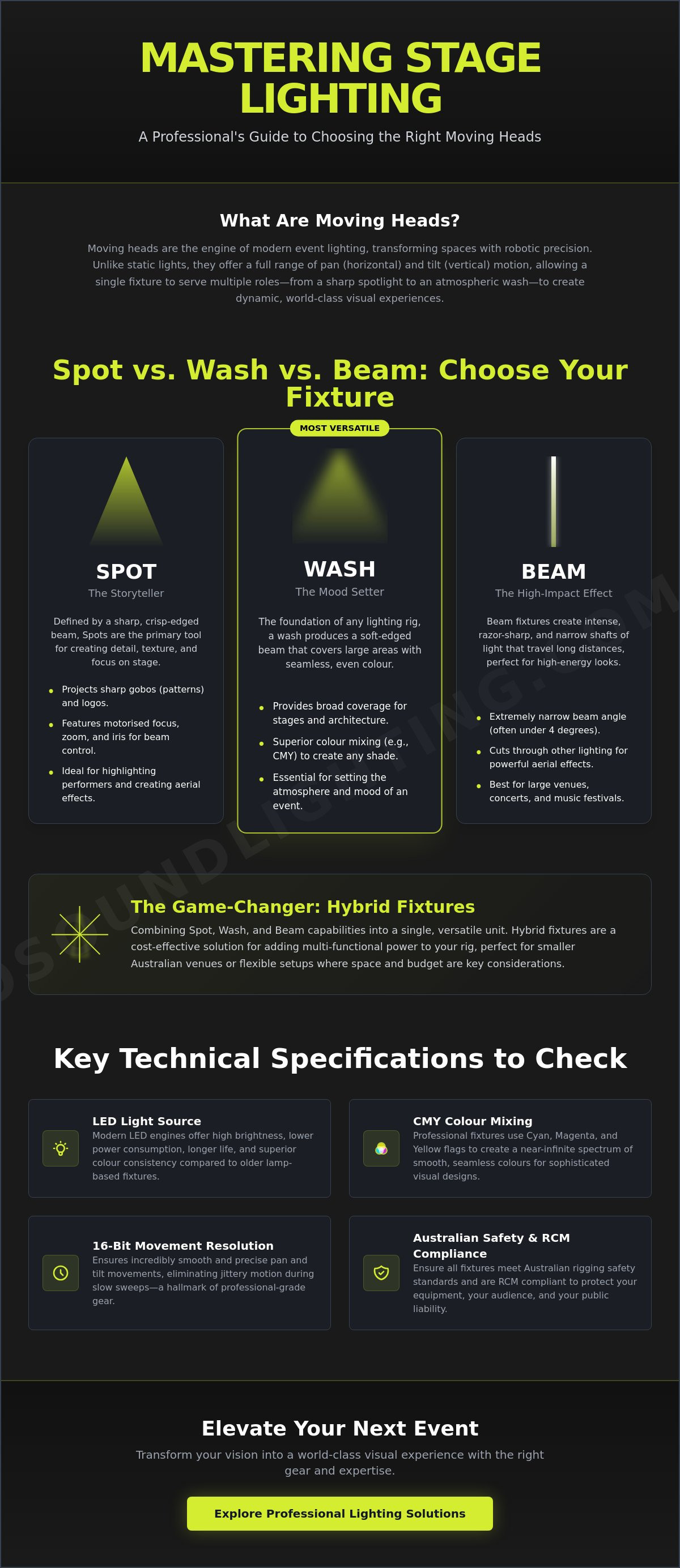
Selecting the right Moving Heads for your event requires more than just looking at a brightness rating. It is about understanding how different lenses and beam angles interact with your venue's architecture. Professional lighting designers typically categorise fixtures into the "Big Three": Spots, Washes, and Beams. While a single type might suffice for a basic party, a world-class visual experience relies on the interplay between all three to create depth, texture, and movement. For smaller Australian venues where budget or space is limited, the rise of the "Hybrid" fixture has been a game-changer. These versatile units can switch between spot, wash, and beam modes, offering a multi-purpose solution for flexible rigs.
Moving Head Spots: The Storytellers of the Stage
Spots are defined by their sharp, crisp edges and high level of internal detail. They are the primary tool for projecting "gobos" (stencilled patterns) or corporate logos onto surfaces. With features like motorised iris and zoom, a high-quality spot allows you to highlight a single performer with a tight beam or fill the entire stage with complex textures. Precision focus is what separates a professional spot from a budget alternative, ensuring that your branding remains legible and your stage looks polished.
Moving Head Washes: Painting the Stage with Colour
A wash fixture is the foundation of any professional audio-visual installation. These units produce a soft-edged beam that blends seamlessly with other lights, making them perfect for covering large areas without harsh shadows. Superior colour mixing is the hallmark of a great wash light. They allow you to shift the mood of a room instantly, moving from warm ambers for a dinner service to deep, saturated blues for a dramatic performance. If you are unsure which fixture to start with, exploring professional wash options is often the most practical first step for venue illumination.
Moving Head Beams: High-Intensity Visual Architecture
Beams provide the "wow" factor. They produce razor-thin, parallel columns of light that remain tight even over long distances. Because the light is so concentrated, beams can cut through ambient lighting and heavy fog to create stunning mid-air geometry. Designers often use internal prisms to multiply a single beam into a spinning visual structure, which is essential for high-energy music festivals and large outdoor events. When planning these high-intensity setups, you must also consider the legalities of Rigging, Safety, and Programming to ensure your rig complies with Australian public building standards. Matching these fixtures to your venue size is vital; a piercing beam that looks incredible in a national arena might be too intense for a small function room.
Technical Specifications: What to Look for in Moving Heads
While previous sections explored the movement and categories of fixtures, understanding the hardware inside Moving Heads is what ensures your rig performs reliably under pressure. By 2026, the industry has shifted its focus from raw power consumption to optical precision and efficiency. This means looking past simple wattage and investigating the specific light engine and colour system that drives the unit. When you're comparing models, the most critical metric is now lumen output. In the past, higher wattage always meant a brighter light, but modern LED technology has broken that link. A 300W LED fixture can often outperform an older 700W discharge unit while drawing half the power. This efficiency is a massive advantage for Australian venues with limited electrical capacity.
The internal effects engine is another area where professional fixtures prove their worth. Gobo wheels, the stencils that create mid-air patterns, are essential for adding texture to a stage. High-end units typically feature a combination of fixed gobo wheels for rapid-fire effects and rotating gobo wheels for organic, moving textures. When these are paired with motorised focus, you can ensure that every pattern remains sharp regardless of the projection distance.
Light Source Technology: LED vs. Arc Lamps
LED moving heads have become the benchmark for national hire services because they don't require expensive lamp replacements every few hundred hours. They are incredibly robust during transport and offer instant on/off capabilities without a warm-up period. However, high-intensity discharge (HID) or arc lamps still reign supreme in massive outdoor festivals where you need a beam to punch through kilometres of ambient light. LED fixtures offer a lower heat output, which is critical for indoor venue installations.
Advanced Colour and Optical Control
To truly master the visual narrative, you need to understand what are moving heads capable of in terms of colour science. While entry-level units use RGBW (Red, Green, Blue, White) LED chips, professionals often look for CMY (Cyan, Magenta, Yellow) mixing systems. CMY uses graduated glass filters to subtract light, allowing for much smoother transitions and a wider palette of sophisticated pastels that RGBW chips often struggle to replicate.
Versatility also comes down to the optical zoom range. A fixture with a wide 6° to 50° zoom can act as a tight beam one moment and a broad stage filler the next. This flexibility is often enhanced by a "frost filter," a motorised piece of diffusion that softens the edges of a spot light. Using a frost filter allows a single fixture to pull double duty, functioning as both a texture projector and a soft wash light depending on the scene's requirements. These technical nuances are what allow a lighting designer to create a truly world-class visual experience.
Planning Your Rig: Rigging, Safety, and Programming
Once you have selected your fixtures, the focus shifts to the technical execution of your design. Planning a rig is where your creative vision meets the practicalities of engineering and safety. It involves more than just plugging in cables; it requires a calculated approach to power distribution, data networking, and structural integrity. For any large-scale event, the goal is to create a system that is both spectacular to watch and completely reliable behind the scenes. This is especially true for Moving Heads, which require precise control and secure mounting to perform their complex pan and tilt routines without interruption.
Power management is a critical factor that is often overlooked. Even though LED technology has reduced overall consumption, a rig full of automated lights can still pull a significant amount of current, particularly during the initialisation phase when all motors move simultaneously. You must calculate the total amperage of your fixtures to ensure you don't exceed the capacity of your venue's circuits. Additionally, permanent installations benefit from a regular maintenance schedule. Dust and heat are the enemies of internal optics and cooling fans; therefore, a routine health check will significantly extend the lifespan of your investment.
DMX Control and Programming Basics
DMX512 is the universal language used to communicate with your lighting rig. In a professional setup, you'll need to understand "Universes," which are blocks of 512 control channels. Each of your Moving Heads is assigned a specific starting address, allowing the console to send individual commands for colour, position, and gobos. You might choose a dedicated hardware console for tactile, real-time control during a live concert. Alternatively, software-based systems running on a Mac or PC offer incredible flexibility for pre-programmed shows. While sound-to-light modes are great for a casual party vibe, a truly professional visual experience relies on meticulously timed cues that synchronise with the audio and stage action.
Australian Rigging Standards and Safety
Safety is non-negotiable when suspending heavy equipment over an audience or performers. In Australia, all overhead fixtures must be secured with rated safety cables as a secondary bond. This ensures that if the primary clamp fails, the light remains attached to the truss. Professional trussing systems are designed to support these concentrated loads, but they must be assembled and loaded according to manufacturer specifications. For complex professional audio-visual installations, you should always consult with a qualified technician to verify that your rig meets local safety standards and structural requirements. Doing it right the first time prevents accidents and ensures your event runs without a hitch.
Elevate Your Next Event with Pro Sound & Lighting
Pro Sound & Lighting stands as a seasoned partner for those who refuse to compromise on visual excellence. We understand that the technical details of Moving Heads can be overwhelming. That's why we position ourselves as a collaborative partner rather than just a supplier. Our team combines decades of industry experience with a passion for high-quality results, ensuring that every fixture we provide contributes to a cohesive and world-class visual experience. From high-intensity beams that define the architecture of a festival stage to elegant theatrical spots for intimate venues, our inventory is curated for precision and longevity.
We take a comprehensive approach to every project. Whether you are looking for a rental sound package or a full-scale lighting rig, we focus on the result rather than just the specifications. Our role is to remove the stress of technical complexity, allowing you to focus on the performance while we handle the precision. This "Reliable Visionary" approach means we've seen it all and know exactly how to execute a project that meets your specific needs and constraints.
Moving Head Hire Solutions for Every Scale
Hiring equipment is often the most strategic way to access the latest 2026 technology without the significant capital outlay of a full purchase. We offer custom lighting packages that combine Moving Heads with essential stage FX lighting, wash lights, and parcans to create a balanced, professional look. This all-in-one approach ensures that every component of your rig is compatible and optimised for your specific venue. Our professional delivery and setup services mean your equipment is installed correctly and tested thoroughly before the first guest arrives, ensuring your event runs without a hitch.
Permanent Installations for Venues and Theatres
For venues looking to make a lasting impact, our expert audio-visual installations are tailored to your unique architecture. We design integrated lighting systems that are sophisticated in their output yet remain remarkably easy for your venue staff to operate. Investing in high-quality moving head technology provides long-term value, reducing the need for constant upgrades and ensuring your space remains a premier destination for years to come.
We don't just sell gear; we provide a vision for what your space can become. Our team is ready to assist with everything from PA equipment hire to complex projector screen setups, ensuring a seamless integration of sound and light. Contact our team today for a bespoke consultation on your next project and discover how we can help you achieve a superior outcome.
Master Your Visual Narrative with Professional Lighting
Mastering the technical and creative aspects of Moving Heads is about more than just acquiring gear; it's about understanding the physics of your space and the emotional impact of light. You now have the knowledge to distinguish between high-intensity beams and versatile hybrids, ensuring your rig is perfectly matched to your venue's unique architecture. From navigating the shift toward energy-efficient LED sources to implementing rigorous Australian safety standards, you're equipped to plan a world-class visual experience with total confidence.
At Pro Sound & Lighting, we bring over 20 years of industry expertise to every project, offering national Australia-wide service coverage and a premium inventory featuring the latest 2026 lighting technology. Whether you're planning a permanent theatre installation or a high-impact festival hire, our "Reliable Visionary" team is here to remove the stress of technical complexity. It's time to stop worrying about jargon and start envisioning a superior outcome for your audience. Explore our range of professional Moving Heads for hire and installation today and let's transform your stage together.
Frequently Asked Questions
What is the difference between a moving head and a scanner?
A moving head fixture involves the entire body of the light moving to provide a 360-degree range of motion, whereas a scanner uses a moving mirror to deflect the beam. While scanners are faster for rapid effects, they have a much narrower field of movement. Professionals generally prefer the versatility of a moving head for modern stage designs because it offers far more creative freedom in positioning and beam placement.
Can I use moving heads for an outdoor event in Australia?
You can use Moving Heads outdoors provided they have an IP65 weather rating. This specific rating ensures the fixture is protected against the dust and heavy rain common in Australian environments. If your gear isn't IP65 rated, you'll need to use waterproof domes or reliable overhead cover to prevent electrical failure and internal damage. Always check the manufacturer's specifications before exposing equipment to the elements.
How many moving heads do I need for a standard 10-metre stage?
For a standard 10-metre stage, a rig of six to eight fixtures is generally the ideal starting point for a professional visual experience. This allows you to place two units for backlighting, two for texture on the stage floor, and four for mid-air beam effects. Your specific choice depends on whether you're prioritising a broad wash for visibility or high-intensity beams for a high-energy music festival vibe.
Do I need a special controller to operate moving head lights?
Operating these fixtures requires a DMX512 controller or a computer running dedicated lighting software. While some units have basic internal programs, a controller is essential to unlock the full potential of pan, tilt, and colour mixing. You can choose between tactile hardware consoles for live manipulation or software-based systems for pre-programmed, automated shows that sync perfectly with your performance.
What is a "Gobo" and how do I use it with moving heads?
A "Gobo" is a small stencilled disc placed inside a spot fixture to project patterns, textures, or corporate logos onto a surface. In professional Moving Heads, these are often housed on a rotating wheel, allowing the pattern to spin or shake for added visual interest. Using gobos is the most effective way to add depth and narrative to a stage without increasing the number of lights in your rig.
How often do moving head fixtures require professional servicing?
Professional fixtures typically require a thorough service every six to twelve months depending on their operating environment. In dusty Australian venues or high-use hire environments, cooling fans and internal optics can accumulate debris that causes overheating and reduced output. Regular maintenance involves cleaning the lenses, lubricating the stepper motors, and checking for firmware updates to ensure the fixture remains reliable during every show.
Can moving heads be synchronised with music automatically?
Yes, most automated lights can be synchronised with music through a "sound-to-light" mode using an internal microphone. For a more polished and world-class result, professionals use DMX software to timecode specific movements and colour changes to the beat of a track. This level of precision ensures that every visual cue hits perfectly with the audio performance, creating a more immersive experience for your audience.
What are the power requirements for a professional moving head rig?
The power draw of a rig depends on whether you're using LED sources or traditional discharge lamps. A single high-output LED fixture might draw between 150W and 400W, whereas older arc-lamp units can pull significantly more current. It's vital to calculate the total amperage of your rig to ensure you don't overload the venue's circuit breakers, especially during the high-draw initialisation phase when all motors move simultaneously.