
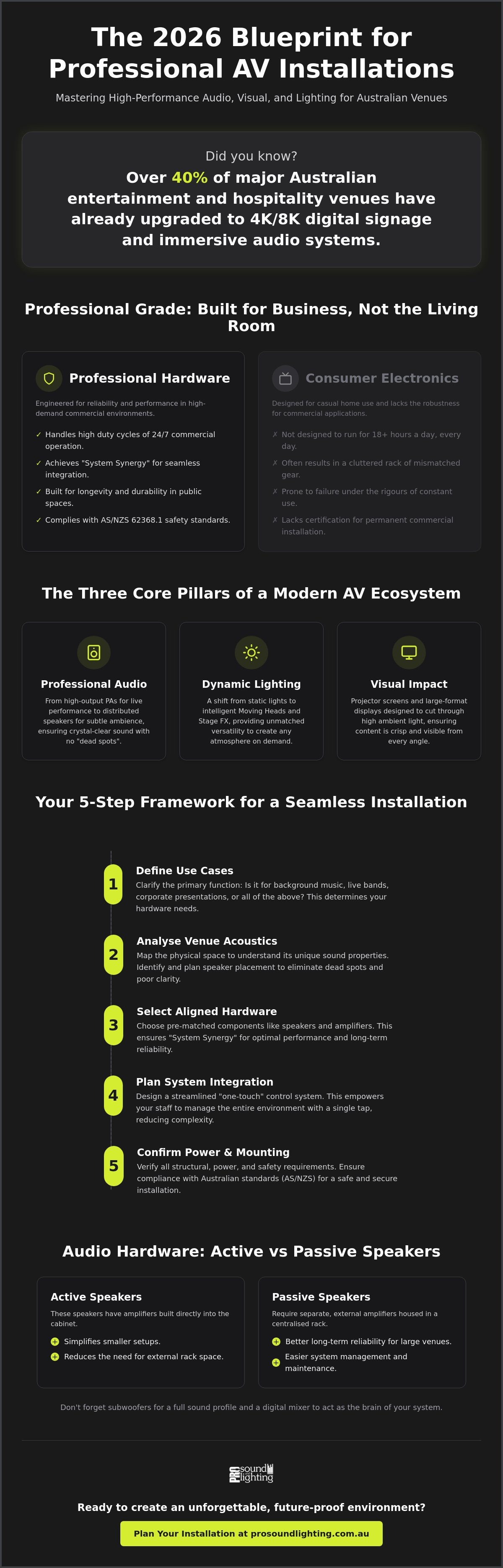
Did you know that over 40% of major Australian entertainment and hospitality venues have already upgraded to 4K/8K digital signage and immersive audio systems? You likely recognise that a professional audio visual installation is no longer just about being "loud and bright." It is a strategic alignment of acoustics, illumination, and interaction that defines your venue’s identity. We understand the frustration of trying to integrate clashing brands or the fear of discovering "dead spots" in your sound coverage just as the doors open. It’s a complex challenge to ensure your lighting isn't too dim for a professional setting or too "disco" for a high-end lounge.
We promise to help you master the art of selecting high-performance hardware to create immersive, future-proof environments for any commercial space. You'll learn how to achieve high-impact visual clarity and durability for 24/7 use without the technical headache. This guide explores the essential components for a seamless, one-touch integrated system, while breaking down the latest AS/NZS 62368.1:2026 safety standards and the rise of AVoIP technology in the Australian market.
Key Takeaways
- Understand the critical differences between consumer electronics and professional-grade hardware, ensuring your system can handle the high duty cycles of 24/7 commercial operation.
- Master the art of a professional audio visual installation by choosing PA equipment that aligns with your venue's acoustics to eliminate dead spots and poor sound clarity.
- Learn how to integrate Moving Heads and Stage FX to create a "performance mode" that elevates your space from a standard room to a high-impact environment.
- Streamline your project with a five-step planning framework that covers everything from defining use cases to identifying essential mounting and power requirements.
- Discover curated hardware combinations, such as pre-matched speaker and amp sets, designed for longevity and precision in modern Australian venues.
What Defines a Professional Audio Visual Installation in 2026?
A professional audio visual installation is far more than just a collection of speakers and screens scattered around a room. In 2026, we define it as a permanent, integrated ecosystem of audio, visual, and lighting hardware specifically engineered for high-performance commercial or entertainment use. To appreciate the technical depth required for these setups, it helps to understand What is Audiovisual (AV) Technology? and how it functions as the sensory backbone of a modern venue. Unlike the gear you might find in a home theatre, professional systems are built to withstand the rigours of 24/7 operation while maintaining absolute signal stability.
The primary difference lies in the hardware's "duty cycle." Consumer gear isn't designed to run for 18 hours a day, every day of the week. Professional-grade components offer the durability and precision needed for public spaces, ensuring your investment doesn't fail when the room is full. This reliability is built on "System Synergy." This concept ensures that every piece of hardware, from the amplifiers to the control processors, communicates perfectly. Australian venues are increasingly moving away from cluttered racks of mismatched gear toward sleek, integrated "one-touch" control centres that allow staff to manage the entire environment with a single tap.
The Core Pillars of Modern AV
Modern installations rest on three essential pillars. First is professional audio, which spans from high-output PA equipment for live performance to distributed ceiling speakers for subtle background ambience. Second is dynamic lighting. We've seen a massive shift from static, hot par cans to intelligent Moving Heads that provide unmatched versatility. Finally, visual impact is delivered through projector screens and large-format displays designed to cut through high ambient light, ensuring your content is crisp and visible from every corner of the room.
Commercial vs. Entertainment Installations
Tailoring your hardware to the specific "vibe" of your space is vital. In office buildings, the priority is often utility, focusing on clear speech reinforcement and seamless screen sharing for collaboration. In contrast, pubs and entertainment venues prioritise atmosphere and impact. These spaces require robust sound systems and FX lighting that can transition from a quiet lunch service to a high-energy evening crowd. Future-proofing these environments requires a scalable digital backbone, allowing you to add new hardware as your venue evolves without ripping out the existing infrastructure. It’s about building a system that grows with your business.
Choosing the Right Audio Hardware: Beyond the PA System
Getting the sound right in a professional audio visual installation involves much more than just cranking the volume. In fact, "louder" is rarely "better" when you're aiming for a premium atmosphere. High-performance audio is about intelligibility and even distribution. You want your guests at the back of the room to hear as clearly as those at the front without deafening the people standing near the speakers. Achieving this balance requires a deep understanding of your venue's unique acoustics and the specific role each piece of hardware plays.
When you're selecting PA equipment, you'll need to decide between active and passive speakers for your permanent mount. Active speakers have built-in amplifiers, which can simplify smaller setups and reduce the need for external rack space. However, for a comprehensive professional audio visual installation in larger Australian venues, passive speakers connected to a centralised rack of amplifiers often provide better long-term reliability. Centralising your power means your technicians can easily manage the system without needing a ladder every time an amp needs a tweak.
Don't overlook the importance of subwoofers. Even in a corporate boardroom or a sophisticated lounge, a dedicated sub provides that "full" sound profile that makes presentations feel more authoritative and music feel more engaging. Managing these various audio sources, from lapel mics to background music, requires a robust audio interface or digital mixer. This hardware acts as the brain of your sound system, ensuring every input is balanced and clear before it hits the ears of your audience.
Speaker Placement and Sound Dispersion
Avoiding "dead spots" is a matter of physics and careful planning. You must consider the speaker's "throw" and coverage angles to ensure sound disperses evenly across the room. Ceiling-mounted systems are often the go-to for minimalist Aussie designs, while wall-bracketed cabinets might suit venues with high, industrial ceilings. Acoustic treatment is the essential practice of using specialised materials to absorb or diffuse sound reflections, which is critical for maintaining speech clarity in modern, glass-heavy Australian venues.
Microphones and Wireless Management
Choosing between handheld, lapel, or boundary mics depends entirely on your specific application. If you're operating in a busy Australian CBD, managing the wireless spectrum is a major priority to avoid interference from neighbouring offices or emergency services. Following established frameworks like the Flinders University AV Room Standards can help you navigate these technical requirements during the planning phase. If you're ready to start speccing your gear, check out our best-selling audio products for your next install. You can also explore our full range of audio solutions to find the perfect fit for your venue's unique layout.
Lighting for Impact: Integrating Moving Heads and Stage FX
While audio sets the mood, lighting defines the visual heartbeat of your space. It's the difference between a room that feels functional and one that feels truly premium. Every modern Australian venue now requires a dedicated "performance" lighting mode to shift the atmosphere instantly. Integrating these elements during a professional audio visual installation ensures your venue can pivot from a corporate briefing to a high-energy launch party without missing a beat. A professional audio visual installation that treats lighting as a core component rather than an afterthought will always yield a higher return on engagement.
Moving Heads are the most versatile tools in your inventory. They offer the ability to project subtle textures and gobos for a sophisticated gala dinner or switch to high-speed beam shows for a live performance. To complement these dynamic movements, Wash Lights and Parcans are essential for painting the room with your brand colours. This reinforces your identity across the entire space. However, these high-output fixtures require more than just a power point. Safety and rigging are paramount. Using professional-grade mounting hardware and certified rigging points is non-negotiable to protect your guests and ensure the longevity of your hardware.
Atmospheric Effects in Permanent Installs
Visual impact often depends on what you can't see until the lights hit it. This is where including Stage FX Lighting such as fog or haze machines becomes vital. These particles in the air catch the light beams, providing visual depth and making your lighting design feel three-dimensional. Modern systems allow you to integrate these effects directly into your AV control system. This enables "one-button" show starts where the haze, audio, and lighting all trigger simultaneously for a seamless experience.
Intelligent Lighting Control
Managing a complex rig doesn't have to be difficult for your staff. While DMX programming offers the ultimate precision for complex shows, automated "sound-to-light" modes provide a helpful fallback for casual use. We recommend installing wall-mounted controllers that use simple, labelled buttons. This makes it easy for non-technical staff to operate the system without needing a lighting technician on-site every day. You can browse our professional lighting collection to see the latest hardware available for your venue's transformation.
5 Steps to Planning Your Professional AV Installation
A successful professional audio visual installation isn't an accident. It's the result of methodical preparation and a clear understanding of your venue's goals. Jumping straight into buying hardware without a plan often leads to expensive mid-project corrections. To ensure your system delivers the high-impact results you're after, follow this structured approach to your planning phase.
- Step 1: Define the primary and secondary use cases. You must decide if your space is primarily for quiet corporate presentations, high-energy live music, or a mix of both. A multi-purpose room requires more flexible hardware than a dedicated cinema.
- Step 2: Conduct a thorough site survey. Check your power availability and identify structural mounting points early. Knowing if you're dealing with concrete or timber before the gear arrives will save hours of frustration during the physical install.
- Step 3: Budget for the total project. It's easy to focus on the price of the speakers, but you must also account for cabling, mounting brackets, and the professional commissioning of the system. These "hidden" costs are vital for a safe and polished finish.
- Step 4: Select a scalable hardware ecosystem. Choose brands that play well together. A unified ecosystem allows you to expand your professional audio visual installation in the future without needing to replace your core control hardware.
- Step 5: Schedule a professional calibration. Once the hardware is in place, it needs to be tuned. Calibrating your audio for the room's acoustics and your lighting for the sightlines ensures the system performs at its absolute peak.
When you're ready to start your project, contact our team for expert advice on your venue's unique requirements.
Common Mistakes to Avoid
One of the most frequent errors is under-speccing the visual elements. A 75-inch TV might look impressive in a shop, but it can appear like a postage stamp in a large hall. You also need to prioritise cable management. Messy, exposed wires are the hallmark of a "home job" and can create safety hazards in a commercial setting. Finally, don't forget about user training. Even the most advanced system is useless if your staff don't know how to turn it on or switch between modes.
Budgeting for Longevity
The "cheapest" quote often leads to the highest long-term maintenance costs. Professional-grade gear is built for the high duty cycles of 24/7 use, whereas budget alternatives often fail under pressure. We always recommend looking for hardware with Australian-backed warranties. This ensures you aren't left stranded if a component needs service. You can find the right hardware for your budget here, ensuring you get the performance you need without overspending on unnecessary features.
Standout Hardware Solutions for Australian Installations
Selecting the right gear is the final, most critical step in bringing your venue’s vision to life. When you're finalising your professional audio visual installation, the quality of your hardware dictates the longevity of your investment. High-performance venues require components that don't just look good on paper but actually perform under the unique environmental conditions found across Australia. From high-ceiling event spaces to sun-drenched coastal bars, your choice of hardware must be deliberate and purposeful.
High-Output Moving Heads are essential for venues with significant vertical space. These fixtures provide the punch needed to cut through ambient light and reach the floor with clarity. To complement the visuals, high-brightness projector screens and LED panels are the gold standard for impact, ensuring your content remains crisp even in rooms with large windows. For audio, we recommend professional PA packages. These pre-matched speaker and amp sets take the guesswork out of system design, ensuring that power ratings and impedance are perfectly aligned for guaranteed sound quality and reliability.
Immersion often comes down to the subtle details. Integrating Stage FX like snow or fog machines can transform a standard retail or stage environment into a multi-sensory experience. These atmospheric tools are no longer just for concerts. They are increasingly used in permanent installs to add visual depth to light beams and create memorable "wow" moments for guests. When these elements are combined with a "one-touch" control system, your venue becomes a versatile powerhouse capable of hosting any event with ease.
Top Picks from the Pro Sound & Lighting Collection
Our curated selection focuses on hardware known for its resilience in the Australian climate. We've identified specific Moving Heads that offer exceptional heat dissipation and dust resistance, making them ideal for long-term mounting. For architectural highlights or corporate branding, our compact Wash Lights provide rich, saturated colours without a bulky footprint. If you're managing a smaller space, we offer all-in-one PA systems that provide "plug-and-play" simplicity while maintaining the high-fidelity sound your audience expects.
Why Partner with an Industry Veteran?
Success in this field requires more than just a catalogue of products. With over 20 years of experience in the Australian entertainment technology industry, we bring a wealth of practical knowledge to every project. We understand the nuances of both temporary hire and permanent installation. This dual perspective allows us to recommend hardware that is not only high-impact but also easy to maintain over years of 24/7 use. Ready to upgrade? Shop our best-selling products today and take the first step toward a superior venue experience.
Ready to Future-Proof Your Australian Venue?
Creating a high-performance environment requires more than just high-end gear; it demands a strategic alignment of hardware, acoustics, and lighting. You've seen how a professional audio visual installation relies on the durability of commercial-grade components and the precision of "one-touch" integrated control. By prioritising system synergy and following a methodical planning process, you ensure your space remains adaptable and engaging for years to come.
With 20+ years of industry expertise and national Australian support and distribution, we are here to help you navigate the technical complexities of modern entertainment technology. We offer a comprehensive range of professional stage and audio hardware designed to meet the rigorous demands of 24/7 commercial use. Whether you're aiming for high-impact visual clarity or immersive sound distribution, our team has the experience to bring your vision to life.
Upgrade your venue with our best-selling professional AV hardware and experience the difference that expert-backed solutions can make. We look forward to helping you create a space that truly resonates with your audience.
Frequently Asked Questions
How long does a typical professional audio visual installation take?
The timeframe for a standard installation varies depending on the scale and complexity of your project. A basic single-room setup or boardroom can often be completed within two to three days. Larger, multi-zone venues that require extensive cabling, structural mounting, and complex hardware integration may take several weeks from the initial site survey to the final commissioning phase.
Can I integrate my existing speakers into a new AV installation?
You can often integrate your existing speakers, provided they are in good working condition and compatible with modern amplification. However, mixing older passive gear with a new professional audio visual installation requires careful impedance matching to prevent hardware damage. We usually recommend a full system audit to ensure your legacy equipment won't become a point of failure in an otherwise high-performance ecosystem.
What is the difference between a wash light and a spot light?
A wash light provides a wide, soft-edged beam that "washes" a large area or wall with a uniform layer of colour. In contrast, a spot light produces a narrow, sharp-edged beam designed to highlight a specific person, object, or architectural feature. Most Australian venues use a combination of both to create visual depth and focus during different event modes.
Do I need a special permit for installing high-powered lasers or stage FX?
You must comply with specific safety standards for high-powered lasers, such as those governed by ARPANSA in Australia. For Stage FX like fog or haze, you don't typically need a legal permit, but you must coordinate with your building's fire safety technician. This ensures your atmospheric effects don't accidentally trigger smoke detectors or fire suppression systems during operation.
How often should a professional AV system be serviced?
We recommend a professional service every six to twelve months to maintain peak performance and hardware longevity. Regular maintenance involves cleaning projector filters, checking cable terminations, and updating firmware on digital mixers and lighting consoles. For venues running 24/7, more frequent quarterly inspections can help identify potential hardware fatigue before it leads to a system failure.
Is wireless audio reliable enough for a permanent commercial installation?
Wireless audio is highly reliable for permanent installs if you use professional-grade hardware and proper spectrum management. In busy Australian CBDs, we utilise digital wireless systems that can automatically switch frequencies to avoid interference from neighbouring signals. While a wired connection is always the most stable, modern wireless technology is robust enough for critical speech and live performance applications.
What is the best way to control both lighting and sound from one device?
The best way to manage your environment is through a centralised control processor paired with a customised touch panel or wall-mounted interface. This allows you to trigger pre-programmed "scenes" that adjust both lighting and sound levels simultaneously with a single tap. It removes the technical complexity for your staff and ensures your professional audio visual installation is operated exactly as intended every time.
Why should I choose professional-grade gear over consumer electronics for my business?
Professional-grade gear is engineered for high duty cycles and 24/7 operation, whereas consumer electronics are designed for only a few hours of daily use. Commercial hardware also features robust mounting points, balanced audio connections for long cable runs, and Australian-backed warranties that cover business use. Investing in professional equipment significantly reduces your long-term maintenance costs and prevents embarrassing failures during trade.