
Could a single lamp choice be the difference between a flat, uninspired performance and a production that leaves your audience breathless? You've likely felt that familiar sting of anxiety when faced with a technical rider full of jargon like Fresnel and Parcan, or worried if your venue's power supply can handle the heat of a full rig. It's a common hurdle for even the most seasoned organisers who want their event to look world-class without the technical headache.
We understand that the right stage lighting hire is about more than just visibility; it's about directing the emotional pulse of your show. This guide promises to demystify the technical nuances of modern illumination, helping you master everything from colour temperature to the new 2026 energy efficiency standards for LED lamps. You'll gain the confidence to communicate effectively with technicians and select a setup that suits your venue size perfectly. We'll explore the practical differences between traditional tungsten and modern LED fixtures, ensuring your next production is both compliant with Australian safety standards and visually stunning.
Key Takeaways
- Understand the technical distinction between a lamp and a luminaire to communicate clearly and confidently with your lighting crew.
- Identify the ideal moments to use Fresnels for soft washes or Profile Spots for sharp focus to create professional visual textures.
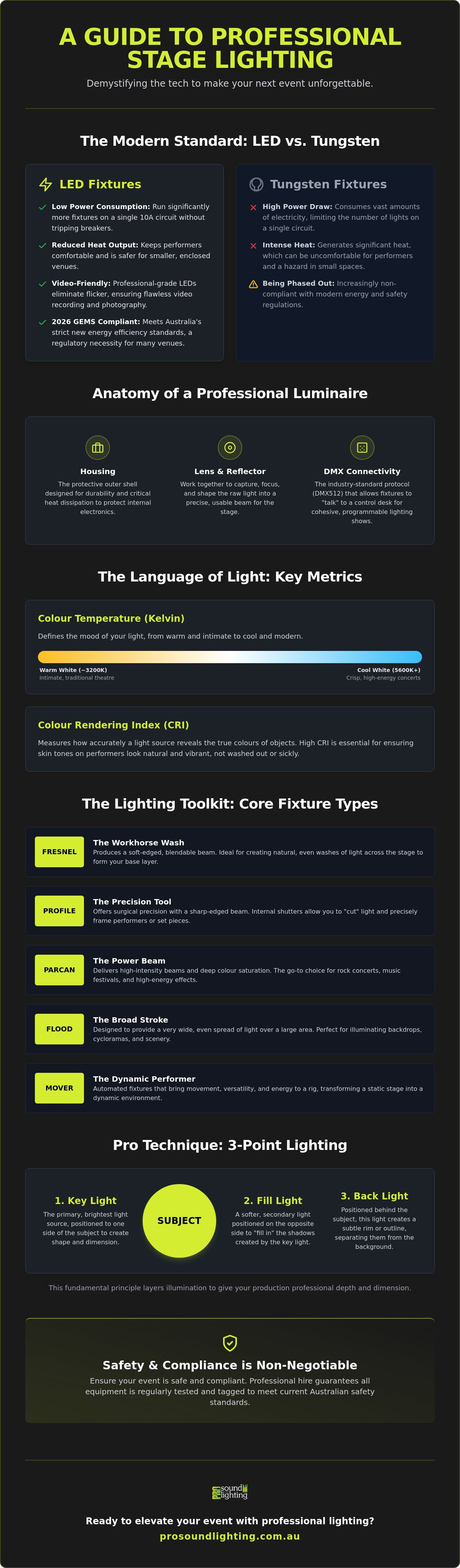
- Discover how modern LED technology enables you to run more fixtures on a single 10A circuit while significantly reducing heat on stage.
- Apply the 3-point lighting principle to layer your illumination and provide your production with professional depth and dimension.
- Ensure your event is safe and compliant by selecting a stage lighting hire that guarantees all equipment is tested and tagged to current Australian standards.
What is a Stage Lamp? Defining Modern Theatre Illumination
In the world of performance, a "lamp" is far more than a simple glass bulb you'd find in a bedside table. When you're looking at stage lighting hire, you're actually selecting a sophisticated luminaire, a complete unit designed for precision and durability. These fixtures are the backbone of Modern Theatre Illumination, serving three non-negotiable purposes: providing visibility so the audience can see the action, creating focus to guide the eye, and establishing the emotional mood of a scene.
Visibility is your baseline, but mood is where the magic happens. A well-placed shadow can be just as powerful as a bright wash for telling a story. The industry has moved rapidly from the hot, power-hungry incandescent bulbs of the past to the versatile LED technology we use today. This shift isn't just about saving electricity. High-quality professional fixtures are engineered to eliminate the "flicker" effect that often ruins video recordings and photos, ensuring your production looks as good on a smartphone screen as it does from the front row.
With the 2026 Greenhouse and Energy Minimum Standards (GEMS) now in effect across Australia, the transition to LED is no longer just a creative choice; it's a regulatory necessity for many venues. Professional stage lighting hire ensures you're using equipment that meets these strict efficiency and safety requirements without sacrificing the artistic quality of your show. Using the right gear means you don't have to worry about tripping breakers or overheating a small community hall.
Anatomy of a Professional Lighting Fixture
The outer shell, or housing, does more than just look sleek. It's a critical component for heat dissipation, ensuring the internal electronics don't fail during a long set. Inside, the reflector and lens work in tandem to shape the light into a usable beam. Without a high-quality lens, your light would simply spill everywhere without purpose. Modern fixtures also feature DMX connectivity. DMX512 is the industry-standard protocol that turns a collection of individual lamps into a cohesive, programmable system, allowing every lamp in your rig to "talk" to the control desk for seamless transitions.
Key Metrics: Lumens, Lux, and Colour Temperature
Choosing the right vibe for your event starts with understanding colour temperature, measured in Kelvin. Warm white (around 3200K) mimics traditional theatre lamps and creates an intimate, inviting atmosphere. Cool white (5600K and above) feels crisp and modern, perfect for corporate presentations or high-energy concerts. Beyond brightness, you must consider the Colour Rendering Index. CRI is the measure of how accurately a light source reveals the true colours of objects. For performers, a high CRI is essential; it ensures skin tones look natural rather than washed out or sickly under the spotlight. Precision in these metrics is what separates a DIY setup from a professional-grade production.
Core Categories of Stage Lamps for Every Production
Choosing the right fixture is about matching the physical properties of a light to your creative goals. In the world of stage lighting hire, you aren't just picking a generic light; you're selecting a precision tool designed for a specific task. Understanding the Basics of Good Stage Lighting Design helps you realise that each category of lamp has a unique personality. Whether you need a soft, natural glow for a community play or high-intensity beams for a music festival, there's a fixture engineered for that exact purpose.
Fresnels are the undisputed workhorses of the theatre. They produce a soft-edged beam that's incredibly easy to blend with other lights, making them the ideal choice for natural stage fills. Profile Spots, often called Ellipsoidals, offer the opposite: surgical precision. These allow you to create sharp edges and use internal shutters to "cut" light away from set pieces. For high-energy events, Parcans provide the high-intensity beams and deep colour saturation required for rock concerts. If you need to illuminate large backdrops or scenery, Floodlights and Cyc Lights provide an even, wide spread of light. Finally, Moving Heads bring automation to your rig, offering dynamic movement and versatility that can transform a static stage into a living environment.
Fresnels and Wash Lights: Creating the Base Layer
When you need broad coverage that feels organic and inviting, starting with a base layer of wash lighting is essential. We often recommend using Wash Lights / Parcans / Bars to ensure the entire performance area is bathed in a consistent, flicker-free glow. The 'barn door' accessory is a vital addition for these fixtures. These metal flaps attach to the front of the lamp, allowing you to control spill and direct light away from the audience's eyes. This makes them perfect for school assemblies and corporate presentations where clarity and comfort are the top priorities.
Profiles and Followspots: Directing Audience Focus
Directing audience focus requires fixtures that can isolate a performer from their surroundings. Profile spots use internal shutters to shape light around set pieces, ensuring only the intended area is illuminated. For live performances or awards nights, a followspot is the ultimate tool for tracking movement across a stage with a bright, focused beam. You can also add incredible visual depth by using gobos. These small plates project intricate textures, patterns, or even company logos directly onto the stage floor or walls. Our team can help you organise a tailored lighting rig that includes these precision tools to make your next event truly stand out. High-quality stage lighting hire ensures you have the right mix of these categories to suit any venue size.
LED vs. Tungsten: Addressing the Heat and Power Objection
One of the most frequent questions we receive during a stage lighting hire consultation is whether LED fixtures can truly match the performance of traditional tungsten lamps. For decades, the warm, amber glow of a tungsten filament was the gold standard for theatre. However, technology has advanced rapidly. Modern LEDs no longer produce the "flat" or clinical light of earlier models. They now offer a sophisticated alternative that addresses the two biggest headaches for production managers: power consumption and heat.
In many Australian community halls and heritage venues, power is a precious commodity. A single 1000W tungsten Parcan draws roughly 4.2 amps of power, meaning you can only safely run two fixtures on a standard Australian 10A circuit before risking a tripped breaker. In contrast, an equivalent LED fixture might draw as little as 150W. This efficiency allows you to rig significantly more lamps on a single circuit, giving you greater creative freedom without the need for expensive three-phase power upgrades or external generators. Beyond the power board, there is the matter of temperature. Tungsten lamps are essentially heaters that produce light as a byproduct. Switching to LED keeps your performers cool under the spotlight and prevents the stage from becoming an oven, which is a vital consideration for summer productions in Australia.
The introduction of RGBAL (Red, Green, Blue, Amber, Lime) LED engines has also revolutionised colour mixing. By adding amber and lime chips to the standard mix, these fixtures can achieve incredibly high CRI levels and replicate the specific "warmth" of incandescent light with surgical precision. You're no longer limited to the physical gels you have in your kit; you have millions of colours available at the touch of a fader.
The Longevity and Reliability Factor
Blown bulbs are the bane of any stage manager's existence, often occurring at the most inconvenient moment mid-show. LEDs virtually eliminate this risk, boasting lifespans that far exceed the 750 to 1,000 hours typical of a high-output tungsten lamp. This reliability is why Moving Heads have almost entirely transitioned to LED sources. While early LEDs struggled with "steppy" dimming, professional-grade fixtures now feature sophisticated dimming curves that mimic the natural, smooth fade-to-black of a traditional lamp, ensuring your transitions remain elegant and professional.
When Traditional Tungsten Still Wins
Despite the benefits of LED, traditional tungsten still holds a place in the Australian stage lighting hire market. There is a specific, organic warmth to an incandescent filament that is difficult to perfectly replicate for vintage aesthetics or period-specific dramas. Tungsten fixtures can also be a cost-effective solution for short-term, low-complexity hires where the venue already has a robust analogue dimming system in place. In some heritage centres, the existing infrastructure is designed specifically for these older loads, making them a simpler "plug-and-play" option for smaller community groups on a tight budget.
Designing Your Rig: How to Organise Your Stage Illumination
Designing a lighting rig is about more than just hanging fixtures in a line. It is the process of building a cohesive system where every lamp has a specific job to do. When you approach stage lighting hire with a "system" mindset, you move beyond simple visibility and start creating a three-dimensional environment. The foundation of this approach is the 3-point lighting principle. By using a key light as your primary source, a fill light to soften shadows, and a backlight to separate the performer from the scenery, you create a sense of depth that makes the production feel professional and polished.
Layering is the next step in mastering your rig. This involves combining the soft washes of Fresnels with the sharp, punchy beams of Profile spots we discussed earlier. Safety must always be your primary concern when you light the stage. In Australia, all rigging must adhere to the AS/NZS 60598.2.17 standard, which covers the secure mounting of luminaires for theatre and studio use. This includes the use of secondary safety bonds and ensuring your total power load is carefully calculated. Even with the efficiency of modern LEDs, you must verify that your venue's 10A or 15A circuits can handle the combined draw of your lamps, moving heads, and audio equipment.
Creating Atmosphere with Colour and Texture
Colour is your most powerful tool for influencing the audience's emotional state. Cool blues and cyans can instantly transport a scene to a cold night, while warm ambers create an intimate, candlelit feel. For transitions or high-impact moments, integrating strobe lights can add a layer of energy that static lamps simply cannot match. The psychological impact of beam angles also matters; steep, top-down lighting can feel oppressive or dramatic, while low-angle lighting can create a sense of mystery or unease. If you're unsure which fixtures will best achieve your vision, you can enquire about our custom lighting packages to find the perfect balance for your venue.
Technical Planning and Plotting
A smooth "bump-in" depends entirely on your technical planning. Creating a detailed lighting plot ensures that every member of the crew knows exactly where each lamp should be hung and which DMX address it has been assigned. DMX addressing is the digital roadmap that allows your control desk to communicate with individual fixtures, giving you total command over intensity, colour, and movement. We recommend a pre-show 'flash through' to verify every lamp is responding correctly. This simple check ensures that no cable has come loose and every fixture is patched to the right fader before the doors open to the public. Professional stage lighting hire provides the reliability you need to focus on the creative execution rather than technical troubleshooting.
Professional Stage Lighting Hire and Installation Solutions
Taking your production from a creative vision to a physical reality requires more than just a list of equipment. Choosing a reputable partner for your stage lighting hire ensures that every piece of gear arrives on-site in peak condition. In Australia, the safety of your crew and audience is paramount. Professional hire companies provide equipment that is rigorously tested and tagged according to AS/NZS 3760 standards. This level of diligence prevents electrical faults and ensures your production meets the compliance requirements of local councils and venue managers alike.
Whether you are organising a primary school musical in a local community hall or a sprawling outdoor festival, your lighting needs will be vastly different. A tailored approach allows you to scale your rig to fit the physical constraints and power limitations of your specific site. Beyond the physical hardware, having access to expert technical support provides essential peace of mind. Knowing that an industry veteran is available to help troubleshoot a DMX patch or a power load issue on your opening night allows you to stay focused on the performance itself. High-quality stage lighting hire is as much about the expertise behind the gear as it is about the fixtures themselves.
Customised Hire Packages for Australian Events
Every event has a unique rhythm and scale. Our range of options spans from basic Parcan setups for simple visibility to advanced Moving Head rigs that create high-energy atmospheres. For a seamless event experience, many organisers choose to combine their lighting with PA equipment hire to ensure the audio and visual elements are perfectly synchronised. We offer flexible hire durations that account for the reality of production schedules, including bump-in days, technical rehearsals, and multi-night performance runs. This flexibility ensures you aren't paying for gear when it isn't being used, while still having the time needed for a perfect setup.
Expert Installation and Venue Upgrades
For schools, theatres, and venues looking for a permanent solution, professional Audio Visual Installations offer the ultimate way to future-proof your space. An integrated system removes the need for messy temporary cabling and ensures your venue is always ready for a show at the flick of a switch. We don't just install the gear; we provide comprehensive training for staff and students to ensure they feel confident operating new consoles and fixtures. If your current setup feels outdated or unreliable, you can Contact the Pro Sound & Lighting team for a comprehensive venue audit. Our experts will assess your infrastructure and recommend a pathway toward a professional-grade environment that serves your community for years to come.
Transform Your Vision into a Professional Reality
Mastering the nuances of stage lamps is about more than just technical specifications; it is about having the tools to tell a story with precision and emotional impact. As we move through 2026, the transition to energy-efficient LED technology ensures your production remains compliant with Australian standards while offering unparalleled creative flexibility. By understanding how to layer your rig with the right mix of Fresnels and Profile spots, you can create a high-end atmosphere that captivates your audience from the very first cue.
With over 20 years of Australian industry expertise, Pro Sound & Lighting provides the national delivery and support you need for total peace of mind. Whether you require Red Dot Award-winning design insights for a permanent installation or a tailored stage lighting hire package for a touring festival, our team is here to help you navigate the complexity of modern illumination. We pride ourselves on being a collaborative partner that values both technical proficiency and your unique creative excellence.
Elevate your next event with professional stage lighting hire from Pro Sound & Lighting. We look forward to helping you light up the stage for your next successful Australian production.
Frequently Asked Questions
What is the most common type of stage lamp used in theatre?
The Fresnel is the most common fixture found in theatres due to its incredible versatility and soft, adjustable beam. It is the primary choice for creating a natural, even wash across the performance area without harsh edges. While Profile spots are essential for precision, the Fresnel remains the workhorse for general illumination in almost every Australian community hall and professional venue.
Can I plug a professional stage lamp into a standard Australian power outlet?
Most modern LED fixtures are designed to plug directly into a standard 10A Australian power outlet. However, it's vital to calculate your total load, as traditional high-wattage tungsten lamps often require 15A circuits or dedicated dimming racks. When organising your stage lighting hire, always verify the venue's power capacity to ensure you don't trip a breaker mid-performance.
What is the difference between a Fresnel and a Parcan?
A Fresnel features a stepped lens that creates a soft-edged, zoomable beam, while a Parcan produces a fixed, intense "pool" of light. Fresnels are perfect for blending colours and lighting actors naturally. In contrast, Parcans are typically used for high-energy effects, deep colour saturation, and punchy beams that cut through a busy stage environment during concerts or festivals.
How many stage lamps do I need for a medium-sized school stage?
A medium-sized school stage typically requires between 12 and 20 fixtures to achieve a professional-grade result with full coverage. This usually consists of six to eight profiles for front-of-house lighting and a dozen wash lights or Parcans rigged over the stage. Every venue is different; therefore, it's best to consult a professional to tailor a rig to your specific dimensions.
Do I need a special controller to operate hired stage lights?
You will generally need a DMX lighting controller to manage the intensity, colour, and timing of your hired fixtures. While some basic LED lamps have "stand-alone" modes, a dedicated console is necessary for programming specific cues and ensuring a polished show. Most stage lighting hire packages include a user-friendly controller designed specifically for your rig size and complexity.
Is LED stage lighting bright enough for outdoor events?
High-output LED technology is now powerful enough to rival traditional lamps even in large-scale outdoor environments. LEDs are actually preferred for many outdoor festivals because they draw significantly less power, which reduces the strain on portable generators. Their ability to produce vibrant colours without physical gels makes them an efficient and visually stunning choice for night-time events in any weather.
What does 'DMX' mean in the context of stage lighting?
DMX stands for Digital Multiplex, which is the industry-standard language that allows your lighting console to talk to your fixtures. It sends a digital signal through a shielded cable to tell each lamp exactly what colour and brightness it should be at any given moment. This protocol is what enables complex, synchronised light shows and automated movement in modern theatrical productions.
How do I choose between hiring a spot or a wash light?
Select a spot light when you need a sharp, defined beam to isolate a single performer or project a textured pattern. If your goal is to bathe a large area or the entire stage in a consistent, even colour, a wash light is the correct tool. Most successful productions use a combination of both to create depth and direct the audience's focus effectively.